
No products in the cart.
CapSkip Browser Extension Guide
Learn how to install and configure the CapSkip browser extension for automatic CAPTCHA solving.
The CapSkip Browser Extension connects your browser to the CapSkip application running on your computer or server and automatically solves supported CAPTCHA challenges.
When a CAPTCHA appears, the extension sends the request to CapSkip through the configured Server IP and Port. CapSkip solves it locally and returns the result, which the extension automatically applies on the page.
The extension supports image CAPTCHAs, Google reCAPTCHA, and Cloudflare Turnstile.
Browser Extension Installation
Install the CapSkip browser extension to automatically detect and solve supported CAPTCHA challenges while browsing.

Installation
The CapSkip extension is available for Chrome, Firefox, and Chromium based browsers.
You can install the extension directly from the official browser stores:
Chrome users can install it from the Chrome Web Store.
Firefox users can install it from the Firefox Add-ons store.
For other Chromium based browsers such as Brave, Edge, Opera, or Vivaldi, you can install the extension from the Chrome Web Store because these browsers support Chrome extensions
Extension Connection & CAPTCHA Types
Configure how the browser extension connects to the CapSkip application and select which CAPTCHA types should be detected and solved automatically while browsing.
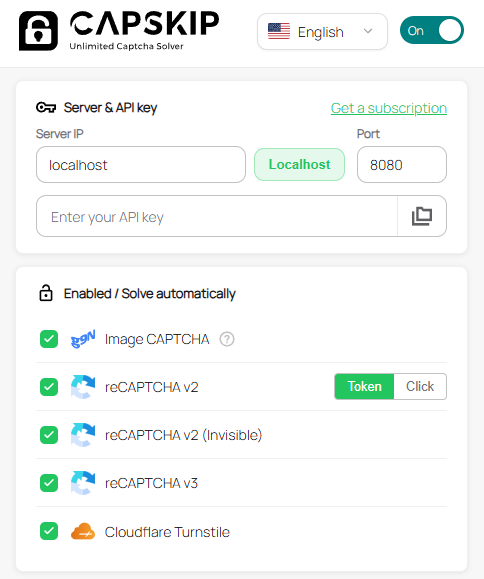
On / Off Toggle
Use this switch to enable or disable automatic CAPTCHA solving in the browser. When turned On, the extension will detect supported CAPTCHA challenges and send them to CapSkip for solving automatically. When turned Off, the extension remains inactive and no CAPTCHA requests will be sent to CapSkip.
Server & API Key
This section connects the browser extension to your local CapSkip application. The extension sends CAPTCHA solving requests to the CapSkip server running on your machine or VPS.
To use the extension, make sure the Service Emulator in the CapSkip application is set to 2captcha.com.
1. Server IP
Enter the IP address where CapSkip is running.
localhost should be used when CapSkip is installed on the same computer as the browser.
If CapSkip is running on a VPS or remote server, enter the server’s public IP address.
2. Port
Specify the port configured in CapSkip. The default port is 8080.
The extension will send requests to IP:Port to communicate with the CapSkip API.
3. API Key
Enter your CapSkip API key if API key validation is enabled in the CapSkip application.
The API key adds an extra security layer to ensure that only authorized applications or extensions can send CAPTCHA solving requests to your CapSkip instance.
If API key validation is disabled in the CapSkip settings, this field can be left empty.
Enabled / Solve Automatically
This section lets you choose which CAPTCHA types the extension should detect and solve automatically when browsing.
1. Image CAPTCHA
Automatically detects and solves supported image-based CAPTCHAs through the CapSkip application.
For image CAPTCHA solving to work, you must configure the image element as the CAPTCHA source and define the input field where the solved result should be inserted.
See the Image CAPTCHA Setup section for detailed instructions.
2. reCAPTCHA v2
Handles Google reCAPTCHA v2 challenges. Two solving modes are available:
Token – Automatically retrieves the verification token and submits it to the page.
Click – Simulates human-like clicking on the CAPTCHA image challenge.
3. reCAPTCHA v2 (Invisible)
Solves invisible reCAPTCHA v2 challenges that run automatically when a form is submitted or a button is clicked.
4. reCAPTCHA v3
Processes reCAPTCHA v3 verification requests and returns the required token to the page.
5. Cloudflare Turnstile
Automatically solves Cloudflare Turnstile challenges detected on supported websites.
Image CAPTCHA Solving Setup
To solve image CAPTCHAs automatically, configure the extension to detect the CAPTCHA image and define the input field where the solved result should be inserted. This setup usually only needs to be done once per website.
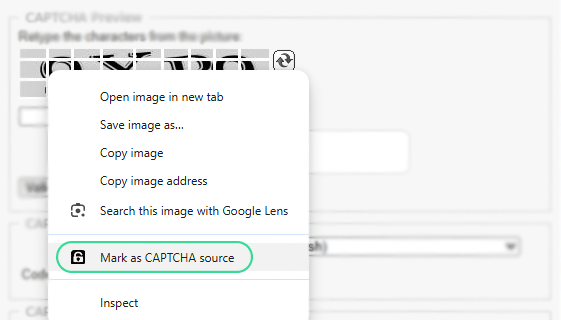
Mark As CAPTCHA Source
Use this option to define the image element that contains the CAPTCHA challenge.
Right-click on the CAPTCHA image displayed on the website and select “Mark as CAPTCHA Source” from the menu. This tells the extension which image should be captured and sent to the CapSkip solver.
Once marked, the extension will automatically extract the image whenever a CAPTCHA appears and send it to the CapSkip application for solving.
This step is required for image CAPTCHA solving, as it allows the extension to identify the correct image element on the page.
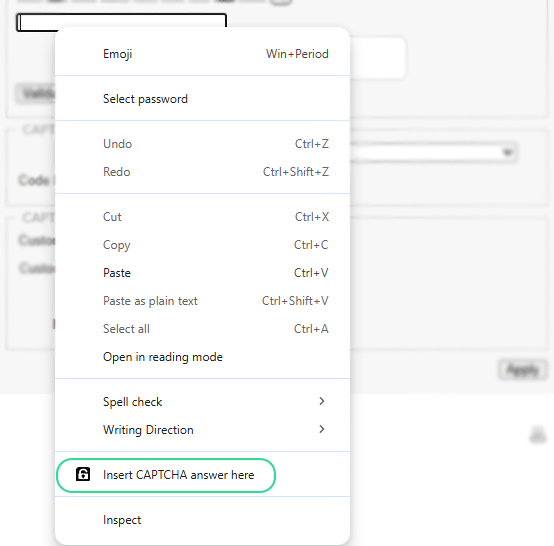
Insert CAPTCHA Answer Here
Use this option to define where the solved CAPTCHA result should be inserted.
Right-click on the input field where the CAPTCHA answer should appear and select “Insert CAPTCHA answer here” from the menu. This tells the extension which field should receive the solved text returned by CapSkip.
Once configured, whenever the CAPTCHA image is solved, the extension will automatically insert the result into this input field. This completes the setup required for automatic image CAPTCHA solving in the browser.
Extension Settings
This section allows you to control how the CapSkip browser extension behaves while browsing.
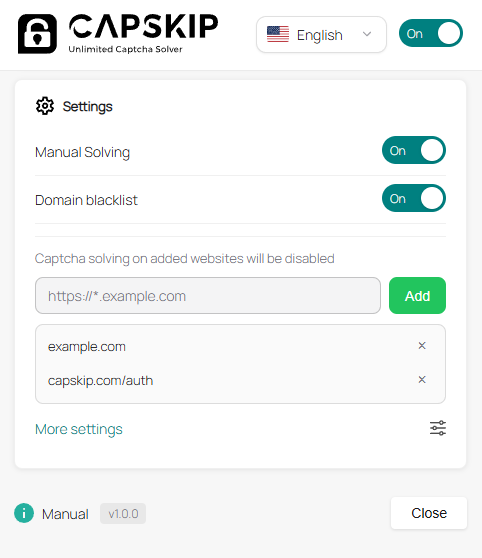
Manual Solving
When enabled, CAPTCHAs will only be solved when you manually trigger the solving action. This gives you full control over when requests are sent to the CapSkip application. When disabled, supported CAPTCHAs will be solved automatically.
Domain Blacklist
This option lets you disable CAPTCHA solving on specific websites. When enabled, the extension will ignore CAPTCHAs on any domain added to the blacklist.
More Settings
Opens additional configuration options for the extension. Optional settings are available in the section below.
Form Automation
This section provides optional automation features that can run after a CAPTCHA has been successfully solved.
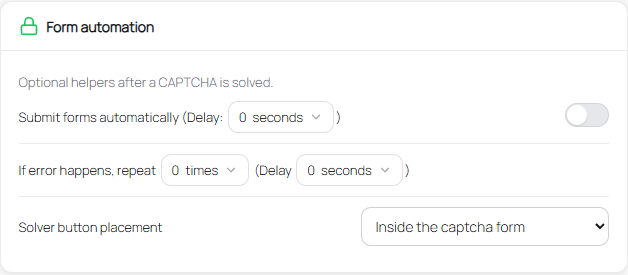
Submit Forms Automatically
When enabled, the extension will automatically submit the form after the CAPTCHA is solved. You can define a delay in seconds before the submission happens.
Retry on Error
If a solving error occurs, the extension can automatically retry the process. You can specify how many times it should retry and set a delay between each attempt.
Solver Button Placement
Choose where the manual solver button should appear on the page.
Inside the CAPTCHA form – The solver button will appear near the CAPTCHA area inside the form.
Fixed on the page (bottom right) – The solver button will appear as a floating button fixed at the bottom-right corner of the page.
AutoSubmit Rules
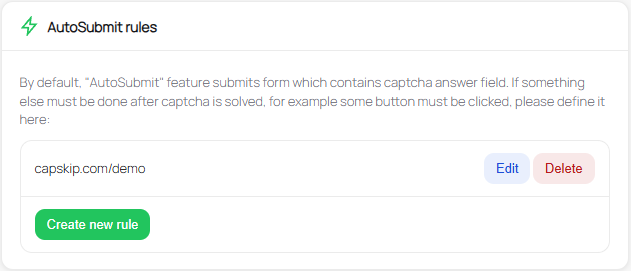
This section allows you to define custom actions that should run after a CAPTCHA is solved.
By default, the AutoSubmit feature automatically submits the form that contains the CAPTCHA answer field. However, some websites require additional steps after the CAPTCHA is solved, such as clicking a specific button or triggering another action. In those cases, you can create custom rules here.
Create New Rule
Click Create new rule to add a new AutoSubmit rule for a specific website.
URL Pattern
Define the website where the rule should apply. The extension will execute the rule only on pages that match this URL pattern.
Sequence of Actions
The Sequence of Actions field defines the steps the extension should perform after the CAPTCHA is solved. Each action represents a command executed by the extension to interact with elements on the page.
Actions are written as individual JSON objects, one per line, and are executed from top to bottom in the order they appear.
Each action contains a type and a value, and some actions may include additional arguments using args.
Basic Structure
Each action follows this format:
{"type":"ACTION_TYPE","value":"ACTION_VALUE","args":[...]}Multiple actions are written on separate lines, for example:
{"type":"source","value":"document"}
{"type":"method","value":"querySelector","args":["#submit-button"]}
{"type":"method","value":"click"}
In this example the extension will:
Start from the page document
Find the element matching the selector
#submit-buttonClick the selected element
Because actions run sequentially, the order of the lines is important.
Common Actions
1. source
Defines the starting context where elements will be searched.
Example:
{"type":"source","value":"document"}2. method: querySelector
Selects an element using a CSS selector.
Example:
{"type":"method","value":"querySelector","args":["#submit-button"]}This finds the element with the ID submit-button.
3. method: click
Triggers a click on the currently selected element.
Example:
{"type":"method","value":"click"}This simulates clicking the element selected in the previous step.